
Water Pooling Around Foundation
Water standing against your house after every storm is not a landscaping problem. In Florida it is groundwater and roof water with nowhere to go, and it works its way into the slab. We collect it, move it and keep it away for good.
Florida Groundwater ◆ Engineered Collection ◆ Lifetime Warranty ◆ Licensed CGC1539326
Why Water Pools Around Your Foundation
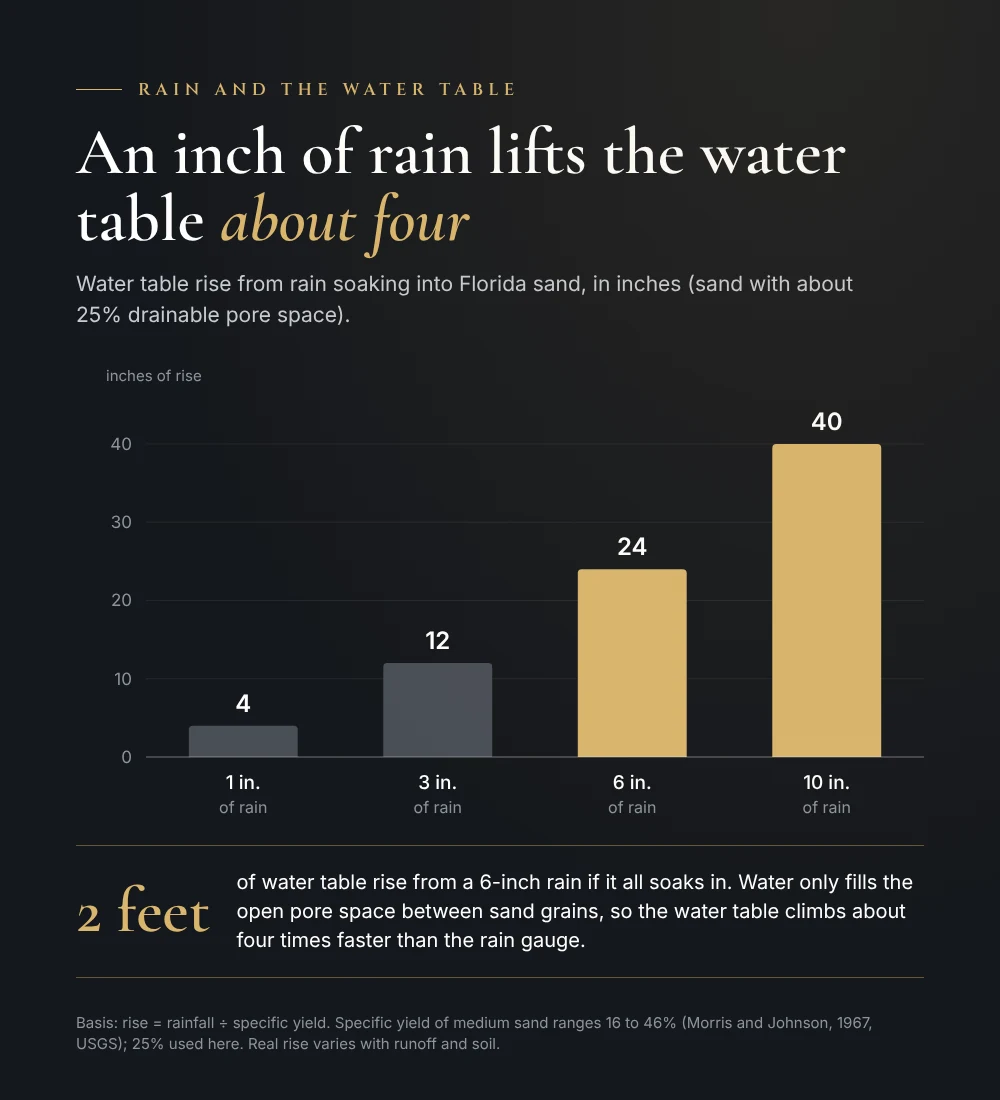
Florida is flat, sandy and wet. When a summer storm hits, the sand soaks up water fast until it is full. Then the water table rises, sometimes to just below the surface, and the next inch of rain has nowhere to soak in.
At the same time, the roof is collecting thousands of gallons and dropping them a few feet from the wall. The slab sits at the lowest, wettest spot on the lot, so that is where the water stops.
That is why the pooling comes back after every heavy rain, and why it gets worse from June through September. See how the Florida water table works.
The Water Behind the Puddle
Why a few storms can put so much water against one house.
623 gal
run off each 1,000 square feet of roof. A 4,000 square foot roof sheds about 2,500 gallons in a single one-inch storm.
49.5 in
falls in an average year, and about 61% of it comes from June through September.
~4 in
rise in the water table for every inch of rain once the sand is soaked, leaving pooled water no place to drain.
Sources: USGS Water Science School, National Weather Service Tampa Bay, 1991–2020 normals, USGS specific yield compilation.
Is Pooling Water Getting Into the House?
At the Foundation
- Water still standing a day after rain
- Soggy soil or moss along the slab edge
- Dark, damp stucco at the base of the wall
- Peeling paint or rust stains low on the wall
In the House
- White crust on the slab or grout lines (efflorescence)
- Cupped wood floors or lifting tile
- Musty baseboards and swollen trim
- Flooring adhesive that lets go
If you see signs inside, the water is already under the slab. That calls for waterproofing, not yard work.
Why the Usual Fixes Fail in Florida
Most advice online comes from places with hills, clay soil and deep water tables. It tells you to slope the dirt away from the house and point the downspouts farther out.
On a flat Florida lot that only moves the water a few feet. The sand next to the house is already full, the water table is already high, and the water comes right back up from below. It also does nothing for the water already under the slab.
A real fix collects the water before it reaches the foundation, carries it in a sealed pipe and sends it to a legal discharge point, with a pump when gravity cannot do the work.
How We Stop Water Pooling at the Foundation
Perimeter Collection
A collection line along the foundation, built with clean stone, filter fabric and smooth-wall pipe.
Roof Water Tie-In
Downspouts piped underground into the system, so roof water never lands at the wall.
Sump & Pump
A sealed sump with a pump sized for Florida storms, for lots too flat to drain by gravity.
Legal Discharge
Water sent to a storm inlet, street gutter or retention pond where the site allows.
Waterproofing
Where water has already reached the slab or walls, we seal the structure itself.
Documentation
Photos, scope and a lifetime transferable warranty for owners and future buyers.
From Puddle to Permanent Fix
Inspect
Moisture mapping inside and out, plus the slab, walls and site.
Trace
Roof water, groundwater, elevations and where the water can legally go.
Design
A system sized for the water, engineered by Foundation Masters where needed.
Install
Clean, concealed work that is finished to match the property.
Warranty
Lifetime and transferable, documented for the home.
More on Florida Water
Water Pooling Around Foundation: FAQ
Is water pooling around my foundation a problem?
Yes, if it keeps happening. Water that stands against a slab or stem wall soaks the soil under the house and pushes moisture up through the concrete. Over time that shows up as white mineral deposits, cupped wood floors, musty baseboards and damp stucco at the base of the wall.
How long should water stand after a rain?
In well-drained Florida sand, surface water near the house should be gone within a few hours. If it is still standing the next day, the soil is saturated or the water table is high, and the water has nowhere to go.
Will regrading or extending my downspouts fix it?
Usually not in Florida. Most lots are nearly flat and the water table sits a few feet down, so there is little room to slope the ground and the water comes back up from below. We design a system that collects the water and takes it somewhere it can legally go.
Do I need a French drain or waterproofing?
If the water stays out in the yard, a properly designed and installed French drain can move it. If the water is reaching the house, the slab or the walls, the house needs waterproofing.
How much does it cost to fix water pooling around a foundation?
Every system is sized after an inspection. A typical collection line with a sump pump starts around $9,000 plus the electrical to run the pump. Larger homes, deeper water and commercial buildings cost more.
Is the work warrantied?
Yes. Our systems carry a lifetime warranty that transfers to the next owner of the home.
Water Standing Against Your House?
Call 813-614-4830 or send the form below. We will find where the water is coming from and design the fix.