Commercial Waterproofing Orlando

Commercial Waterproofing Orlando protects offices, hospitals, schools, hotels, warehouses, multifamily buildings, retail centers, parking structures, and institutional facilities from water-driven damage. Seasonal storms, shallow groundwater, flat sites, sandy soils, and high-volume roof and pavement runoff can raise hydrostatic pressure, erode soils, crack slabs, shift walls, damage finishes, and interrupt building operations. Early water control costs less than late-stage structural repair.
1) Why Commercial Waterproofing Matters in Orlando
- Storm downpours: heavy rainfall rapidly loads soils and increases lateral pressure on below-grade walls, slab edges, joints, elevator pits, and utility penetrations.
- Shallow groundwater: seasonal groundwater spikes can elevate pore pressure beneath slabs, footings, equipment rooms, elevator pits, and lower-level areas.
- Sandy and fill soils: erosion and piping can create voids beneath slabs and footings, causing settlement, cracking, and structural movement.
- Flat grading and large impervious areas: roof runoff, parking lots, sidewalks, and loading areas can concentrate water at the footing line if drainage is not properly designed.
Resources:
Drainage Problems Orlando ·
USGS Groundwater Florida ·
FEMA TB-1 Hydrostatic Forces
2) How Water Damages Commercial Foundations and Interiors
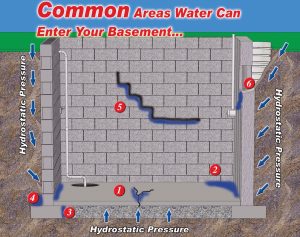
- Hydrostatic pressure: saturated soils push laterally on CMU and concrete walls, causing cracking, bowing, seepage, and interior water intrusion.
- Soil erosion and piping: uncontrolled runoff carries fines away from the structure, creating hidden voids, slab settlement, and footing rotation.
- Uplift and heave: rising groundwater increases upward forces beneath slabs, causing floor movement, tile damage, joint separation, and equipment-area distress.
- Vapor migration: moisture moving through slabs and joints can cause efflorescence, flooring adhesive failures, elevated humidity, and mold complaints.
- Detail failures: penetrations, cold joints, elevator pits, podium decks, planters, expansion joints, and utility openings often leak when they are not waterproofed as a complete system.
When water intrusion is tied to site drainage or groundwater movement, review our Drainage Problems Orlando page for related water-management solutions.
3) Priority Areas to Waterproof in Commercial Buildings
Below-Grade and Slab-on-Grade Areas
- Basement walls, retaining walls, stem walls, and under-slab membranes
- Elevator pits, lift shafts, sump wells, and equipment rooms
- Cold joints, expansion joints, saw cuts, and MEP penetrations
- Loading docks, trash rooms, wet utility rooms, and service corridors
- Foundation edges at downspouts, low spots, and roof-discharge areas
- At-grade lobbies, storefronts, entries, and door thresholds in flood pathways
- Podium decks, parking decks, and occupied spaces below exterior surfaces
Above-Grade and Building Envelope Areas
- Roof decks, plaza decks, and traffic-rated waterproof coatings
- Planters over occupied space requiring root and infiltration control
- Parapets, coping, wall caps, and façade control joints
- Window and door systems at grade requiring flashing and sealant detailing
- Wall penetrations for utilities, piping, conduit, and mechanical systems
- Stair towers, exterior landings, balconies, and deck transitions
4) Our Commercial Waterproofing Systems
- Exterior wall waterproofing: sheet membranes, bentonite systems, liquid-applied barriers, protection boards, and drainage composites to reduce pressure against the structure.
- Under-slab vapor control: vapor retarders, taped seams, turn-ups, sealed penetrations, and terminations designed to protect interior flooring and finishes.
- Interior drainage systems: channels, sump systems, protected discharge routing, backup planning, and backflow prevention.
- Crystalline and integral waterproofing: admixtures and negative-side treatments for new construction and areas where excavation is limited.
- Joint and penetration detailing: waterstops, hydrophilic strips, injection ports, penetration boots, sealants, and repair detailing.
- Deck and surface protection: traffic-rated deck coatings, plaza waterproofing, podium deck systems, and negative-side repairs where required.
Related services:
Commercial Waterproofing Florida ·
Foundation Waterproofing ·
Drainage Problems Orlando ·
Drainage Problems Sarasota
5) Timeline of Risk Escalation
- 0–24 hours: storm rainfall elevates soil moisture, wall pressure spikes, and minor seepage may appear along joints or penetrations.
- 1–7 days: ponding develops at slab edges, hairline cracks may appear, and damp finishes or odors may begin.
- 30–90 days: settlement or heave can become measurable, flooring failures increase, and efflorescence may become visible.
- 6–12 months: movement can become more established, increasing downtime, repair scope, and cost.
6) Our Commercial Waterproofing Workflow
- Assessment: review site drainage, building elevations, slab conditions, wall details, waterproofing history, and visible distress.
- Moisture investigation: inspect seepage paths, vapor behavior, slab moisture, wall staining, cracks, joints, and penetrations.
- System design: select waterproofing, drainage, vapor-control, joint-treatment, and discharge systems based on actual site conditions.
- Installation: coordinate work sequencing with ownership, property managers, tenants, general contractors, and trades.
- Documentation: provide photos, scope notes, repair locations, product/system details, and warranty information where applicable.
7) Structural Repair and Reinforcement Options
When water intrusion has already caused cracking, wall movement, slab distress, or structural deterioration, waterproofing may need to be paired with stabilization or reinforcement. Foundation Waterproofing 101 also provides advanced repair systems for concrete, masonry, beams, columns, slabs, and structural components.
Learn more about our Carbon Fiber Structural Repairs for Concrete Beams, Columns, Slabs and Bridges.
10) Why Choose Foundation Waterproofing 101 for Commercial Waterproofing in Orlando?
- 22+ years delivering waterproofing and water-control systems across Florida
- Water Hydraulics expertise focused on groundwater, hydrostatic pressure, drainage, waterproofing, and structural movement
- Minimal downtime planning with phased work designed to keep commercial facilities operating where possible
- Warranty and documentation with clear scopes, photos, system details, and transferable coverage where applicable
11) Request a Commercial Waterproofing Assessment
- Call (813) 614-4830 or book online.
- We inspect drainage, grading, slab details, wall systems, joints, penetrations, and moisture behavior.
- You receive a plan, photos, and a turnkey waterproofing proposal with warranty options.