Florida Water Table
Florida has one of the highest water tables in the country. In many areas, groundwater sits within 2 to 10 feet of the surface and climbs through the May to October rainy season, with the tide and with every storm. Any building at grade sits on top of it. Understanding how it moves is the first step in keeping a foundation dry.
Groundwater ◆ Tides ◆ Rain ◆ Water Hydraulics
Florida groundwater, by the numbers
Florida does not sit on dry ground with water somewhere below. It sits on water: a thin skin of sand over one of the largest aquifer systems on Earth.
2 to 10 ft.
Where groundwater often sits below the surface across much of Florida, closer in the rainy season.
About 4 in.
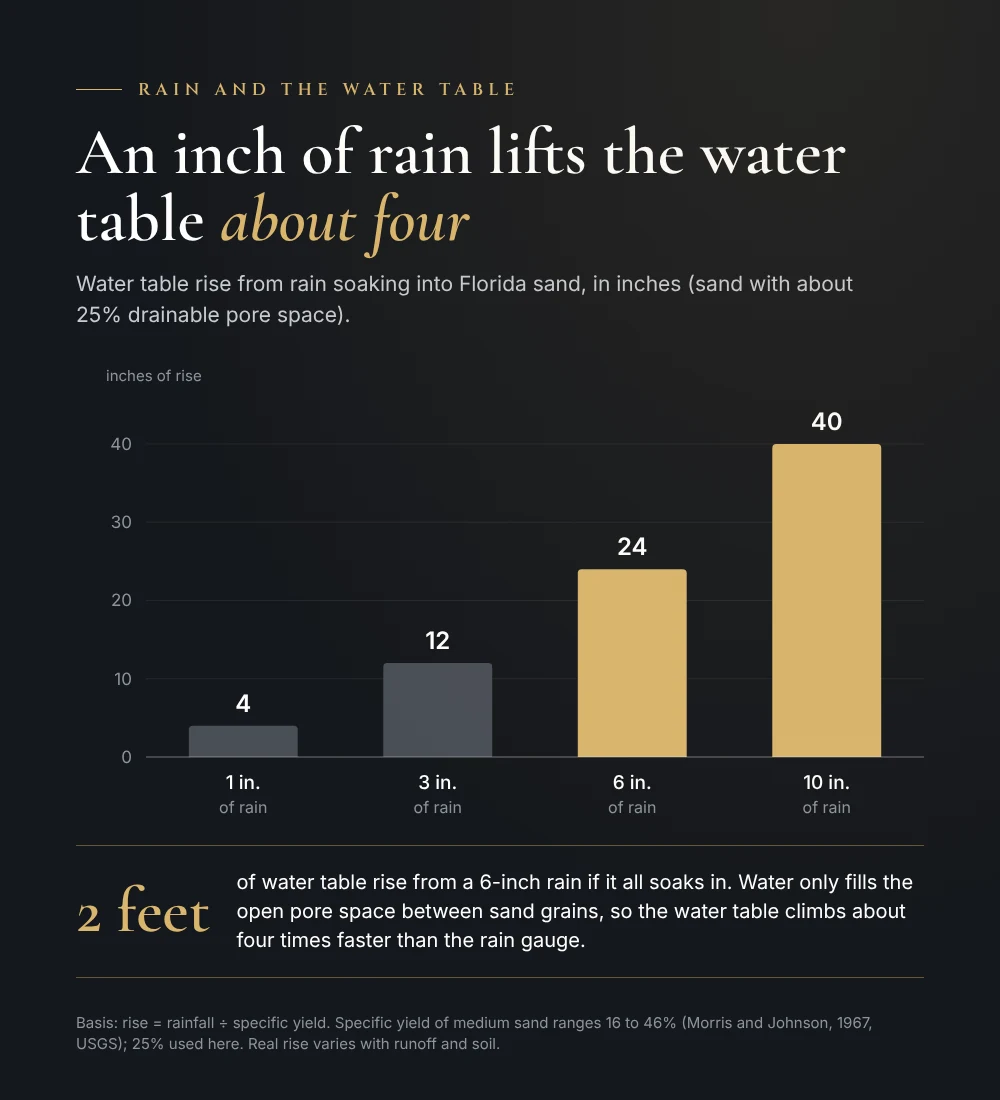
How much the water table can rise in sand for every inch of rain that soaks in.
100,000
Square miles of limestone aquifer beneath Florida and parts of three neighboring states, about 1,000 feet thick on average.
2.36 billion
Gallons of groundwater drawn from the Floridan aquifer per day in 2015.
Sources: St. Johns River Water Management District, USGS specific yield compilation.
Tide + Rain: The Water Hydraulics of a Florida Flood
This is how most Florida properties flood, and it is not from a river or a storm surge. A high tide pushes seawater inland through the ground and forces the water table up. Then the rain comes. The ground is already full, so the rain has nowhere to go. When a structure sits that close to the water and that low in elevation, the combination floods it out from below. That is water hydraulics.
The water table rides a few feet below grade, rising and falling with the tide twice a day.
The highest tides of the year push seawater into the ground and lift the water table under the whole lot.
Heavy rain lands on ground that is already full. The water table reaches the slab and the yard floods from below.
Groundwater Data in Florida
The U.S. Geological Survey and Florida’s water management districts monitor groundwater levels in wells across the state, with real-time readings, decades of history, and records of how the water table responds to rain and drought.
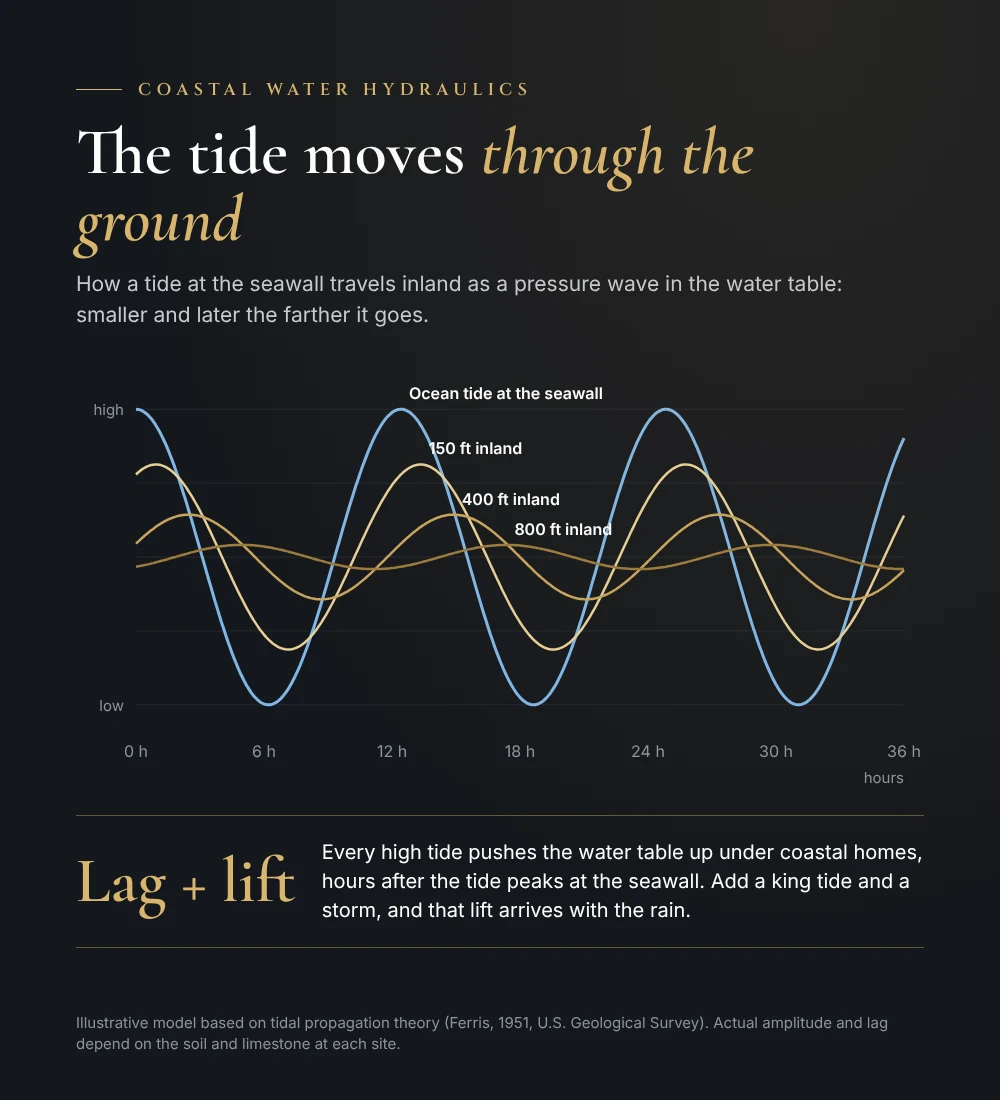
Along the coast, those wells show something most people never see: the tide moving through the ground. A high tide at the seawall arrives under a house hours later as a rise in the water table, smaller the farther inland it goes. That is why a waterfront slab can take on moisture on a clear day, and why we read tide charts as carefully as rain gauges.
- Real-time and historical groundwater levels
- Seasonal highs and lows by region
- Response to rainfall, drought and tides
The Floridan Aquifer System
Beneath Florida lies the Floridan aquifer, one of the most productive aquifers in the world: about 100,000 square miles of limestone, roughly 1,000 feet thick on average, supplying most of the state’s drinking water.
Above it sits a thin layer of sand and clay, and in that layer sits the water table that touches our foundations. In Central Florida the limestone dissolves into sinkholes and lakes, and the water table rises and falls with them. In South Florida the porous Biscayne aquifer connects straight to the ocean. Either way, the ground under a Florida building is wet, and it moves.
How Florida’s Water Table Impacts Foundations
When the seasonal high water table rises, groundwater pushes up on slabs and against below-grade walls. Every foot of water above the bottom of a slab pushes up with 62.4 pounds on every square foot.
If a first-floor slab is effectively at grade, the building behaves like below-grade construction: vapor moves through the concrete, joints seep, wood floors cup and finishes deteriorate unless the assembly is engineered to resist constant moisture.
Designing for a High Water Table (Engineer-Led Approach)
We pair site hydrology, elevations, drainage paths, soil type and tidal influence with groundwater data, and design for peak storm cycles, not dry-season levels. Engineering, when a project calls for it, is provided by Foundation Masters, LLC, Florida Certificate of Authorization CA# 30969.
Perimeter Collection
Collection at the footing that relieves the water table before it reaches the slab.
ExploreContinuous-Duty Pumping
Sump systems with backup power and a reliable discharge point.
Membranes & Joints
Heavy waterproofing membranes and joint detailing for walls and slabs.
Vapor Control
Sub-slab and floor vapor control so moisture stops at the concrete.
Roof Water
Seamless gutters and solid discharge, so rain never adds to the water table at the foundation.
ExploreEvery installation is backed by our Lifetime Transferable Warranty.
Why Water Table Knowledge Matters
A contractor who does not understand Florida’s water table cannot design a foundation waterproofing or drainage plan that works. Proper design has to account for:
Seasonal Swings
Groundwater that moves several feet a year, and more in a wet season.
Tides
A water table that rises and falls under coastal homes twice a day.
Hydrostatic Pressure
Constant upward and sideways pressure on slabs and walls.
System Sizing
Drainage placed and sized for the peak, not the average.
Florida Water Table: FAQ
Does the Florida Building Code address the high water table?
The Florida Building Code has elevation and drainage provisions, but it does not give detailed below-grade waterproofing standards for Florida’s water table. If a slab or space sits at or below the seasonal high water table, it should be treated as below-grade construction and protected accordingly.
Do I need a permit to add drainage or waterproofing in Florida?
Generally no. Waterproofing, sump pumps and exterior drainage do not usually require a building permit. Structural work, such as reinforcing or rebuilding walls, does. We confirm the requirements with the local building department before work starts.
How much can groundwater fluctuate in Florida?
Seasonal swings of several feet are common, with sharper spikes during tropical systems. In sand, every inch of rain that soaks in can lift the water table several inches, and along the coast the tide moves it twice a day. Designs should be built for the seasonal high water table, not average conditions.
What are the signs my slab is interacting with the water table?
Persistent floor cupping, musty odors, recurring efflorescence, seepage at cold joints, or damp baseboards after heavy rain or high tides. These point to vapor or liquid water moving up from the groundwater.
What does an engineered solution include?
Site-specific drainage with perimeter collection and solid downspout discharge, continuous-duty pumping with a reliable outlet, membranes and joint detailing for walls and slabs, and sub-slab vapor control. Documentation includes photos, elevations and a Lifetime Transferable Warranty.
Know your water before it finds you
Call 813-614-4830 or send the form below. We will read the site, the soil and the tide, and design for the water you actually have.