Drainage Problems Miami
As our world evolves, so does the water around it. In Miami, it now comes up through the ground on clear, sunny days. We design engineered drainage for Miami’s porous limestone, king tides and a water table that sits just below the slab, for waterfront estates, historic homes and commercial buildings.
Coral Gables ◆ Coconut Grove ◆ Key Biscayne ◆ Founded 2015
Miami water, by the numbers
Miami’s water is behaving differently than it did when most of its homes and buildings went up. Whatever the cause, the measurements are clear, and drainage has to be designed for the water we have now.
About 6 ft.
Average height above sea level in most Miami neighborhoods, especially near the coast. There is very little room between the slab and the water.
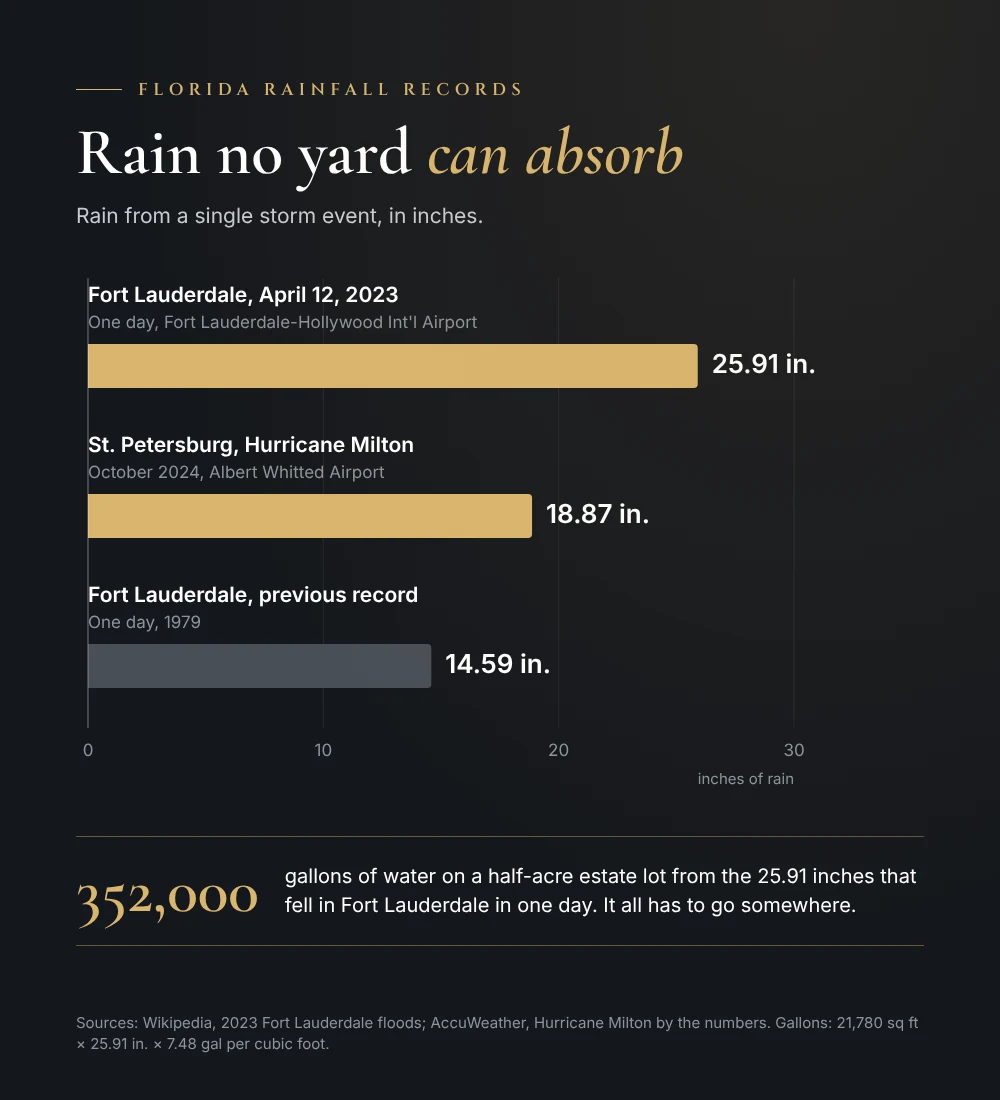
25.91 in.
Rain in a single day at Fort Lauderdale-Hollywood International Airport, the most ever recorded there.
9 in.
Sea level rise per century measured at the Key West tide gauge, one of the longest records in the country.
10 to 12 in.
NOAA’s projected sea level rise along the U.S. coast by 2050. In Miami, the groundwater under the slab rises with it.
Sources: Wikipedia, Miami, Wikipedia, 2023 Fort Lauderdale floods, NOAA tide gauge trends, NOAA 2022 Sea Level Rise Technical Report.
Water around a Miami property is never harmless
Miami has severe drainage problems because of its low elevation, high water table, porous limestone, tropical rainfall, hurricanes, king tides, older drainage systems and flat lots that cannot move water away fast enough. Poor drainage does not just leave standing water behind. It builds hydrostatic pressure, erodes the ground under the slab and works its way into floors, walls and finishes.
Why Miami Has Severe Drainage Problems
Miami is built on the Miami Limestone, the top of the Biscayne aquifer. The U.S. Geological Survey describes this rock as full of cavities and open conduits, which makes it one of the fastest-moving groundwater systems in the country, directly connected to Biscayne Bay and the Atlantic.
That is why a slab in Coral Gables or on Key Biscayne can take on water on a sunny afternoon. When the tide comes up, the water table under the house comes up with it, and during king tides it rises through the ground itself. A seawall cannot stop water that comes up from below.
Much of coastal Miami-Dade, including Miami Beach, Key Biscayne and the bayfront, is mapped by FEMA in high-risk AE and VE flood zones.
Common Drainage Problems in Miami Properties
Outside the Building
- Standing water near the foundation, in the yard, driveway or patio
- Water bubbling up through lawns and pavers during king tides
- Soil erosion and landscape washout after storms
- Earlier fixes that never addressed groundwater or discharge, including French drains that sit in the water table
Water Getting In
- Water entering slabs, crawlspaces or below-grade areas
- Mold odor or high humidity
- Water stains, flooring failure or efflorescence
- Foundation cracks or slab movement
Drainage, Foundation Repair & Waterproofing Work Together
Drainage alone cannot fix a slab that is already wet, and waterproofing alone cannot hold back a water table. Every Miami project starts with an inspection of drainage, grading, water movement, groundwater pressure, slab moisture and foundation conditions, followed by one engineered plan.
Site Inspection
A water flow analysis that separates surface water, groundwater, and roof and discharge problems before anything is designed.
Perimeter Collection
Collection lines at footing level that intercept groundwater and carry it to a sump, not a gravel trench left to fill.
Foundation Waterproofing MiamiSumps and Discharge
Sump pumps with check valves and backflow control, routed to a safe outlet with proper slope.
Wall and Slab Protection
Wall membranes, crack injection and vapor control where water is already reaching the structure.
Roof Water Management
Seamless gutters tied into smooth-wall drain lines, so roof water never reaches the foundation.
ExploreCommercial Drainage
Hospitals, hotels, schools, offices and retail, scoped and scheduled to keep the building open.
Request a ConsultationEvery installation is backed by our Lifetime Transferable Warranty. Read the warranty.
Engineered Drainage Solutions for Miami’s Extreme Water Table
In Miami the groundwater can sit within a few feet of the surface and move with every tide. Shallow swales, surface drains and gravel trenches fail when the water table is already that high: they fill from below and from above, then hold water against the foundation.
Our systems are designed around the soil, the groundwater depth, the rainfall and the discharge point, so slabs and lower levels stay dry through record rain. Engineering, when a project calls for it, is provided by Foundation Masters, LLC, Florida Certificate of Authorization CA# 30969.
Miami Drainage for Older Homes and High-Value Properties
Historic homes and waterfront estates, plus hospitals, hotels, schools, offices and retail across Miami-Dade County.
How Poor Drainage Damages Miami Foundations
Poor drainage creates hydrostatic pressure, soil erosion, voids beneath slabs, settlement, slab moisture, wall cracking, mold risk, and deterioration of the concrete and steel. On a waterfront estate or an income property, that is lost value and, at sale, a disclosure. Florida sellers must disclose known water problems.
Our systems stop the water at the source. Each one comes with clear documentation and a Lifetime Transferable Warranty that goes with the property. Where water has already caused settlement, structural foundation repair is handled through Foundation Masters.
Miami Drainage & Waterproofing FAQ
Why does Miami have so many drainage problems?
Low elevation, a high water table, porous limestone, tropical rainfall, hurricanes, king tides, older drainage systems and flat lots that do not move water away from structures quickly enough.
Can drainage problems damage Miami foundations?
Yes. Poor drainage can create hydrostatic pressure, soil erosion, voids beneath slabs, foundation settlement, slab moisture, wall cracking, mold risk and deterioration of the concrete and steel.
What are signs that a Miami property has a drainage problem?
Standing water near the foundation; flooding in the yard, driveway, garage or patio; water entering slabs or below-grade areas; mold odor or high humidity; foundation cracks or slab movement; soil erosion; and water stains, flooring failure or efflorescence.
Do drainage repairs in Miami require a building permit?
Many drainage, sump pump and exterior water management repairs do not go through the same permitting process as structural work. Structural repair, foundation reinforcement, wall rebuilding or major site work may need additional review. We confirm the requirements with the City of Miami or Miami-Dade County before work starts.
How much does professional drainage repair cost in Miami?
It depends on the water source, groundwater depth, the size of the affected area, discharge options, system type, access, sump requirements, and whether waterproofing or foundation repair is also needed. Miami projects range from targeted drainage corrections to larger engineered water-control systems.
Do you offer free drainage inspections in Miami?
Yes. Call 813-614-4830 or send the form below. We inspect drainage, grading, water movement, groundwater pressure, slab moisture and foundation conditions before recommending a plan.
Related Miami Drainage, Waterproofing & Foundation Services
Schedule Your Free Miami Drainage Inspection
Don’t let king tides, heavy rain and a rising water table put your property at risk. Call 813-614-4830 or send the form below, and we will arrange a visit at your convenience.